23 December 2022
19 December 2019
On the Way - or - Do you believe in magic?

Time's up. Here comes Just Another Manager, to be followed, no doubt, by Yet Another Manager.I'd say I hate to say I told you so, but I hate to say I hate to say I told you so. So I say: I told you so.
Seems like we have a series on our hands. Welcome to part two of Arsenal Managers Get Sacked, Sigh. Farewell, Unai Emery, who couldn't stick around long enough for English speakers to be able to say his name properly. Stress is such a problem for managers.
In the last thirty-three years, Arsenal have waved goodbye to only four permanent managers. When an Arsenal boss is given a single to Stepaside, it tends to be an occasion with heft – the end of a dynasty, the prelude to a succession. George Graham's sacking was explosive and wreathed in scandal. Arsène Wenger's departure was monumental like a retreating glacier. The end of Bruce Rioch's brief but productive tenure was baffling at first, but soon revealed itself to be part of a plan. The end of a manager's term was a sign that one way or another, something was happening.
Just a year and a half separated late Graham from early Wenger – all there was between that grit-turned-stodge and the first hints of the sublime. More than that: it separated two completely different conceptions of the club. There, apparently, for a steady and remarkably fruitful century, solid and deadly as a cannonball, flew Boring Arsenal; suddenly, in its place danced a company of angels (with surprisingly bad disciplinary records). A totally new fundamental truth had been established, displacing the old one. Within months, Boring Arsenal was so long ago that it may as well not have existed. Today, even further removed from that strange idea, somewhere there is an Arsenal fanatic taking time out from dealing with a second divorce by watching a YouTube clip allegedly of pre-1996 Arsenal and wondering what Rotherham have to do with anything.
And sure, the start of the subsequent decline long preceded the end of the Wengerian age, and Wenger was a participant in that decline. But his leaving was an ending. Events since then have shown that he may have been the only person at the club who knew what went where.
Emery’s time as manager had its merits. Arsenal would have qualified for the Champions League if not for the games they lost. There was the occasional display of the elan that had periodically shone right to the end of the Wenger era like a beautiful smile through fading ideals. You might have been tempted to believe that this was just what Arsenal did – that even when times were rough, they would occasionally allow confidence to overwhelm them, if only out of habit. Time gave the lie to such naivety. In part to cover deficiencies in the squad he was given to work with, Emery's tactics from game to game evoked a recurring dream where the protagonist spends an age searching for something before realising they don't actually know what it is they're searching for. The players would second-guess themselves, third-guess, fourth-guess, and eventually just guess. The last year and a half has been a slowly draining battery. The key word is "purposelessness", which enacts itself by starting out full of intent, then hissing to a sorry halt. The sacking of Emery was totally unshocking because no-one had the energy left to be shocked – an unnervingly mundane conclusion.
Just a year and a half. It's nice to think that a team's highest historical standards are a default to which it should return once choppy waters have been sailed through. The [Club] Way will kick in, especially if the team is helmed by men with [Club] DNA. All that success must have happened for a reason: virtue rewarded. This mythologising of past euphoria is one of the pleasures of being a fan, but it hides the reality, which is that your club is just a lifeless spirit needing intervention by an animating force. Or, as one sage put it: you gotta make it happen. The positive thing about this is that you can make it happen. But you can't just wave your Way at the opposition and expect them to fall in line – they have their own narratives to nurture. A past, and the pride, self-aggrandisement, and nervous aspiration that come with it, are useless on their own. Whatever you want has to be dug out of the cold, hard present, and then dug out all over again next time around. A sustained spell of success should, if you're being reasonable, be regarded as miraculous. It will fall apart if not tended to. It might fall apart even if it is tended to, but the tending is mandatory. An era, a self-image, an amour-propre – they’re fragile conceits.
And if a club's upper echelons allow a long-serving manager's reign to drift gently into impotence, if they fail to properly plan for his succession, and if they then fire the successor without much of a plan for his succession, you see what happens when nothing happens. Revealed is the default human state: to faff about cluelessly. A club's default state is to sink towards the bottom, which in this sport is a long way down. The basic aim of a club is to counteract this descent. You hope it's up to the task. Read more... Read more...
14 April 2019
Negative space
The first season I followed the English league was 1989/90. Liverpool won the championship for the eighteenth time. (Next on the leaderboard were Arsenal, with nine titles.) Even then, I knew that this was a completely normal, even banal, occurrence. Liverpool won leagues. That was that. It was the natural state of affairs, and would always be so, like the post-Cold War world peace.
The league and FA Cup Double (capital D) was much more difficult. Even the mighty Liverpool had only won it once. It had been on offer for over a century, yet on only five occasions had anyone won it. NASA got people on the moon more often. Then in nine seasons between 1993/4 and 2001/2, Manchester United and Arsenal won five Doubles between them and made it almost routine — albeit, like Liverpool's league habit, a routine available only to favoured few.
With the establishment of the League Cup in 1960 came a new pinnacle: the Treble. To date, no-one has reached it. But this season Manchester City, the League Cup already in the cabinet, could well do it. They're in the FA Cup final and continue to maintain a Formula 1 tempo in the title race.
And though in the first leg of their quarter-final tie with Tottenham, they seemed unsure about how much they still want to be in the Champions League, they're still there. The Quadruple is usually spoken of as something perfectly plausible in theory but unlikely to exist in real-world conditions. Yet here we are in April, and City are only ten games away from taking their place alongside the Celtic immortals of 1967.
Wouldn't you like to see something you've never seen before?
Then again, which would be more impressive: City conquering the monster called Quadruple and carrying it home draped across triumphant shoulders; or that beast slipping away from another would-be slayer and living to roam free, mighty, and mysterious for at least one more year?
The paradox: to fulfil a grand ambition is to diminish it. If something is special because it’s so difficult to acquire, then its acquisition means that maybe it wasn't that special in the first place. It's been done.
The prize is defined by the strain of those who just fail to win it.
So it would be better if Liverpool were to win the league. Not only would it preserve the Quadruple, but we would get to witness the sating of a once unimaginable hunger, which would no doubt be somehow spiritually uplifting.
Mind you, if we're celebrating the improbable, their long streak of nothingness is to be cherished. If you'd said, way back when, that at least twenty-nine years would elapse before they won their next title, I shudder to think what your peers would have said about you, I really do. For Liverpool not to have won the league since then seems so wrong and is therefore so right. It's the lean in the Leaning Tower. To see logic refuse to slot into place for so long — to see the elastic band stretch and stretch and stretch, knowing it will surely snap soon but just ... not ... yet — is one of sport's exquisite pleasures. It confirms that the game is too big to be apprehended in full — that no-one has this stuff figured out. Liverpool not yet winning another league (not winning yet another league?) is the essential companion to Leicester's success of 2016.
(Twenty-nine years before Liverpool last won the league, Spurs, in black & white, did the first Double in sixty-four years.)
So the ideal shake-out this season would be for City to win the league and then lose to Watford in the Cup final. Then they can do what they like in the Champions League as long as they beat Spurs.

Sorry, what's that you say?
Oh, I see what's happening here: you're basically just jealous of any team other than no-league-titles-for-fifteen-years-is-that-right-so-called-Invincible Arsenal enjoying the success that you, deep in some foul cavern of your soul, feel is your team's by right, and although you are very grudgingly accepting of the current pecking order of English football, you feel that if other teams attain these accolades, it should be in as joyless a manner as possible?
How dare you.
19 July 2018
TWTWCTW

I read previews to get educated, and I even tolerate the predictions of the learned to help set the scene, but (with due admiration for those experts) it is with glee that I see such attempts to give shape to the future confounded by each World Cup. It's in there every time, the mysterious element just beyond your ability to identify or to understand how it got there: the strange light outside in the night, someone else's bloody tooth in your drink.
This edition, more than most, careened from certainty to new certainty contradicting the previous one.
After their opening game against Portugal, it looked as though Spain might be emerging from their post-golden era slump, and that their performance might match the talent they collected, imposing as it yet again was. But it turned out they were just the bad old Spain in the good old Spain's too-big suit. Their performance against Russia was a fascinatingly grim self-parody, a sublime monument to mental paralysis: a vast blank slab.
Germany — as constant for the last dozen years as the old West Germany had been, but more fun — were outeverythinged by Mexico, then knocked on their backsides again by Sweden before getting up and showing, in a desperate flash of pride, that they were still Germany. Their tame surrender to South Korea and their management's offloading of blame onto Mesut Özil exposed a rotten heart and showed that they were in fact the new France (and not in a good way).
Mexico made their standard exit in the last sixteen, but the joy and hope they sparked with some of their performances at least ensured that had been promoted to the rank of this year's Chile.
Colombia's goals against Poland, and their outstanding centre-half pairing of Yerry Mina and Davinson Sánchez, made you optimistic to the point of stupidity. Against Senegal, Colombia were nervous, and then Jamesless, but finally victorious. Against England, they seemed terrified. (Why? Jameslessness?) The terror manifested itself first as destructive cynicism, and then, as it dawned on them that they would actually have to play football to win, in a thrilling urgency that almost won them the match. England had looked composed (if blunt as an attacking force); now it was they who looked scared, misplacing simple passes and resorting to the soothing hoof. Yet they paced their way back into the game like a cyclist dropped on a climb, and given a second chance, they kept their heads when it mattered.
Japan were so frightened of elimination in their last group match against Poland that they ceased to play altogether. Against Belgium, they were courage itself.
"...and at the end of what was an intriguing first half..." is usually the most professional way a commentator can plead with a viewer to watch the rest of a dull game, but the first half of Belgium-Japan really did load the second with possibility. The game was the best of the tournament because it was a complete piece, the first minute tied to the last.
The favourites were struggling to impose their desire on the game, while constantly being undercut by the underdogs. Belgium had most of the ball, but couldn't threaten. Japan attacked with quick, smart passing through midfield, then worked the ball around the Belgian half until, almost invariably, a space opened up on the flank (either one), into which a Japanese player was making a run. The ball would find him, and Belgium would be stretched. In the second half, Genki Haraguchi scored following just such a run.
Then Takashi Inui scored with a long-range shot struck with such apparently maximal transference of energy that he made the ball seem at one leaden and weightless. It was a goal experienced more viscerally than euphorically.
Japan harried Belgium into error after error, but a fluke goal (albeit a pretty one) triggered a torrential comeback from Belgium, finished off with a hurricane of a counter-attack goal to win in stoppage time.
In the next round against Brazil, Romelu Lukaku would snake his way through midfield at high speed before setting up Kevin De Bruyne for Belgium's second, in a virtuosic combination of control over his own body, over the ball and over his own mind (picking his path, laying it off to De Bruyne at just the right time before he himself got clattered). He made the winner against Japan without even touching the ball. His outside-in run drew his marker away from the wing down which Thomas Meunier would run to cross for Nacer Chadli to score, the ball having been dummied on the way by Lukaku. He exhibited so many facets of his game in those two moves that without showing it, the striker Lukaku reminded you what a great goalscorer he is too.

Much of the World Cup is about defeat: teams being beaten by teams soon to be beaten. To watch the World Cup is to become a connoisseur of pain. You get an education in the many ways of the knockout. Japan felt the exquisite agony of giving everything of themselves in almost breaking the order, only to find it twisting violently back into place. Peru sang beautifully, but kept missing the high note. England's consolation for elimination was to step straight into a honeymoon period and to break a cycle of negativity (although we've heard that one before). Poland's defeat to Colombia furthered their Sisyphean run of qualifying and flopping. (Would that Ireland could do that.) Senegal were eliminated on a fair-play tiebreaker: death by bureaucracy.
The exits of Germany and Spain were those of a privileged class being confronted with failings they can't decide whether they want to acknowledge. That of Argentina was the inevitable fate of a broken team. (For the neutral, though — if being a Lionel Messi fan counts as neutral in this fractured age — the whole weird mess was worth it just for his goal against Nigeria. With some players, you slow the video to understand their tricks. With Messi, you do so to understand his simple touches. An image to go along with those of Lukaku is that of Kenneth Omeruo putting his weight on his left foot as he prepared to make a tackle with his right, because he didn't expect Messi's second touch to be taken before the ball had hit the ground from his first, because who would expect that? We are all Kenneth Omeruo.)
Panama's first World Cup appearance was so precious that celebration overcame elimination. Russia and Sweden left the stage contented in their overachievement.
Croatia started the competition looking quite flat, but spent the quarter-final, semi-final and final straining every muscle and wearing away every nerve ending. Their effort was embossed on the latter stages of the tournament. And there in the middle of it was Luka Modrić, whose "gift", as described by Jorge Valdano (a candidate for player of the tournament), "consists [of] filling the game with common sense". He was a still point in a frantic world — but he snapped into tackles as fervently as his teammates did.
And their hopes ran into France, who proved almost casually that they were the best team in the world. Croatia wound up a punch into which they put a lifetime of hope and fury; France bobbed; Croatia whiffed and fell to the canvas. This was the most confounding thing about the whole tournament: that the prize we attach so much importance to should be won at the cost of so little sweat. It made you wonder whether French has a word for 'insouciant'. It was all a bit anti-climactic.
My favourite major tournament, and the one that has therefore become the standard by which I measure others (this is the kind of thing that chooses you; you don't choose it) is the 2000 European Championship. France, the Netherlands, Portugal, and (coming up on the rail) Italy — they, and other teams, fulfilled so many of your expectations of what a championship should have: daring, passion, bitterness, beauty, anguish, surprise, truckloads of drama and, crucially, truly excellent sides putting each other through the ringer. It was, like Belgium-Japan, a total story, but one stretched over three weeks.
If the 2016 European Championship suffered, it was not because the expansion to twenty-four teams allowed more mediocrity to flood in, but because the countries you might expect to be great were not. This World Cup was similar, except that Belgium finally showed much of what they'd been promising for so long, and France showed how great they are by how much they withheld.
But also by how much they gave. There may have been something disturbingly Mourinhoesque about them: a terribly well-organised defence with an attack loosely connected to the front of it. But Kylian Mbappé called to mind the young Ronaldo. Paul Pogba at times looked ten feet tall (his slashing pass to Mbappé in the final to start the move that led to Pogba's goal stands next to Lukaku's finest moments). While everyone else was busy running around looking for the answer, N'Golo Kanté quietly solved the game yet again. And yes, that defence, as a defence should, glorified the art of responsible spoilsporting: Raphaël Varane and Samuel Umtiti were magnificent. Didier Deschamps did, after all, once win a World Cup playing in front of Thuram, Desailly, Blanc and Lizarazu. Maybe he knows a thing or two.
So even if it didn't scream out, the exuberance (the joie de vivre, as we say in English) that uncoiled in their celebrations after winning the trophy could be glimpsed in their play all along.
I wish this year's France could have been serially tested like their counterparts were eighteen years ago by Spain, Portugal and Italy. I've yet to see a World Cup that has lived up to Euro 2000's strengths. But I can hardly say I've ever regretted watching one. Even the bad ones are good. There's too much going on. To add to the above Diego Costa's solo masterpiece of a goal against Portugal, which encapsulated so much about the player (including how he got away with a foul on Pepe to begin with); Nacho and Pavard's twin strikes; the somewhat distressing dominance of European teams; the last half-hour of Switzerland-Serbia; Artem Dzyuba; the flamboyance of Neymar; Iran and Morocco putting the fear of God into Spain and Portugal ... it would barely begin to cover it. So many memorable moments are already forgotten.
And the World Cup has strengths all its own. It's global, and it matters more. We are privileged to see players in such a vulnerable state — to see how much they can bear, in front of the world and the folks back home, to stake on the outcome, which will eventually be defeat for all but that lone escapee.
Pussy Riot's intervention in the final shook you out of your arrogant reverie (before you drift off again) and reminded you that this most important of the least important things is bound up with the most important things and the world's worst people. The paradox is that it's also a relief from those things, and others, to devote a month of intense absorption to what is, at best, a celebration of human creativity and enthusiasm. Even if it is run by FIFA.
In these days after the end of the tournament, when it's now absent, you can think back to before it began, to the blank slate that was the draw and the fixture list, and think about how much has changed, and how little.

13 July 2018
The Past of Football: The World Cup, 1506-2022
Following on from his chapters on Alfbert, Lord Ramsey’s England, statistics, and
1506
A spectator slips a ball into the ring during a bout of the traditional Florentine post-pub fighting game calcio stramascio (Italian for "proper twenty-one-man brawl"). No one notices, but football is invented once more. A group of holidaying Frenchmen challenge the locals to a game. The World Cup is born. Things gets heated, and an irate Frenchman charges an Italian much in the manner of a rhinoceros, which had only recently been invented.
1930
The soccering world plead with their British masters to revive the old World Cup idea. The British say no, but gallantly allow the foreigners to stage a competition by themselves, if they were even capable. The winner of this event would face the champion of the Home Internationals, then the supreme tournament, in a showdown for global supremacy. In the final, Uruguay and Argentina can't decide whose football to use, so they use both. The ref can't keep score, and in the confusion declares Uruguay winners. Reminded of their promise of a super global playoff, the British go oh, we don't know what you're talking about, we're busy that decade, we were joking anyway, shut up, go away, there's a Scottish League-Irish League game on.
1934
With the World Cup hosting rights awarded to Italy, Argentina decide to enter the tournament disguised as Italians, in the hope of profiting from favourable refereeing decisions this time. This fails to work, as the officiating is scrupulously fair and impartial at all times. Despite this, Italy/Argentina win the competition.
To save time, the 1938 World Cup is held simultaneously. Italy/Argentina also win this.
1942
With everyone else too busy killing the flip out of each other, my now late then punctual fifth cousin Bobberidge Lazarus seizes the opportunity to stage the 1942 World Cup in his self-declared microstate Lazarusvania (pictured below). All the other nations of the world being too chicken to turn up, Lazarusvania are declared champions and remain the only unbeaten team in World Cup history except Scotland. The FIFA still won't recognise this because ooh that bloody Sepp Blatter.
1946
The whole world clean forgets about the World Cup! They promise they won't do it again.
1950
200,000,000 people cram into the brand new Maracanã to watch the final game between Brazil and Uruguay. The Uruguayans are victorious, but Jules Rimet has left the Him Trophy under the bed from the war. To cover up his mistake, he points out that since the competition format did not technically include a final, the World Cup actually has no winner. Everyone shrugs their shoulders, goes home and never speaks of the match again.
1954
The FIFA decree that all games will be first to 100 or until it gets dark. The Germans stun the world by beating Hungary in the final. They celebrate by being very friendly to strangers, drinking lots of water, and dancing all night to acid oompah.
1958
Brazil power to glory behind young phenomenon Edson, who celebrates by stealing a name from the tournament's Swedish hosts. He will henceforth be known to all as Pelle. In his victory speech, Pelle declares: "I am much better than Maradona."
1962
Chile and Italy get into a massive fight, but a dog runs on and pees on everyone, and people rejoice in the sheer bloody beauty of the moment. Pelle misses the latter stages of Brazil's triumphant run due to injury, but nonetheless collects his medal in full kit.
1966
England's triumph and subsequent fall from grace have already been extensively covered in this series. Suffice it to add that further research has revealed that a large shipment of grain was dispatched from Felixstowe to Leningrad the day after the final. I'm just leaving that piece of information there.
1970
whoooooooooaaaaaaahhhhhh duuuuuuuude have you seen this it's all like colours and stuff it's so bright and shiny and bluuuuurrrrrry and like green and yellow man look at that yellow it’s the yellowy yellow lellow lellyowest yellow I’ve ever seen where is this place it's sunny like aaaaaaaaall the time dude is it just me or is this game going reeeeeeal sloooooow like they're barely even moving wait did Italy just win their group 1-0 is that weird looking German dude okay he can't stop scoring goals for some reason look at the yellow and the white it's like there's a party in my retinas and everyone's invited OH MY GOD HE'S SHOOTING FROM THE HALFWAY LINE AAAAAAAHAHAHAHAAAAA wait wait what they were two up weren't they weren't they answer me man what the fuck dude I want a Peru shirt is that guy playing in a sling like an actual fucking sling HOLY SHIT HE JUST WENT ROUND THE KEEPER WITHOUT TOUCHING THE BALL FUCK FUCK I CAN'T TAKE THIS THIS IS GETTING TOOOOOOO MUCH they keep passing passing passing what are they doing passing passing passing I feel sick passing passing passing he's just passed it to nobodFUCK MAN IT'S THE FULL-BACK I'm going to die
1974
A World Cup of firsts: Scotland truly become Scotland for the first time; future 40-year-old Dino Zoff concedes a goal for the first time in his life; and the Dutch qualify for their first World Cup (apart from that other time when they were called the Dutch East Indies).
The Dutch had created an entirely new soccering philosophy called Sexy Football, which was a development of the Brazilian style, O Sexy Football, named after Irish missionary priest Fr. Peter O'Sexyfootball (an t-Athair Peadar Ó Soichsighphiotbál). It was invented by Czechoslovakia's 1962 goalkeeper Johan Cruij/yff, who would for inspiration stare for hours at paintings by the old Dutch goalkeeping masters: Vermeer, Mondragon, van der Saenredam, &c. Sexy Football involved players running around all over the place and kicking the crippins out of the other team.
In the final, the Dutch do it so astoundingly magnificently that after 22 minutes the Germans concede defeat. The Germans' captain, Franz 'The Director' Peckinpah, personally hands over the new cup, bought in a trophy emporium in Munich because Brazil had left the old one under the bed from the Mardi Gras. But Cruy/ijff isn't satisfied and holds out his hand again, whereupon Peckinpah gives him the European Nations Trophy cup the Germans had somehow accidentally won two years earlier.
Crui/jyff moves to Spain where he assassinates Franco and retires to stud, siring a master race of footballers with some very short women.
1978
In the last minute of the final, a goalbound shot by the Dutch's Derek Manninger is stopped short of the line when an Argentinian general runs onto the pitch and shoots the ball. The ref waves play on, and Argentina win in extra time. Buoyed by this boost to national confidence, Argentina immediately invade Derrylondonderry but are trampled by a herd of plucky British sheep.
1982
The first ever official World Cup anthem is recorded by The Fall. It is a searing commentary on recent FIFA history: "Put the blame into FIFA Haus, go round there and kick out Rous ... Rous rumbled, Rous rumbled ... I'm João Totale, the yet unborn son ... PELLE'S COBWEB EYES!!!!!". Called "The Goal of Love", its b-side is a reworking of "Bingo Master", telling the story of Sepp Blatter's impeccable handling of the draw for the '82 finals. The single is a global smash in several German cities.
1986
Uruguay's José Batista sets a new World Cup record by getting sent off against Scotland before the draw has even been made. Sócrates refines his penalty technique to the point where he doesn't even have to score anymore. Bryan Robson's sling and Gary Lineker's cast make arm injuries a hip new trend for English kids bored of stealing VW badges. Peter Shilton is outjumped by a tiny man and is quite rightly still unhappy about it to this day. Said tiny man, Diego Maradona, waltzes his way through the knockout rounds, but his effectiveness in the final is blunted as he is marked out of the game by Pelle.
1990
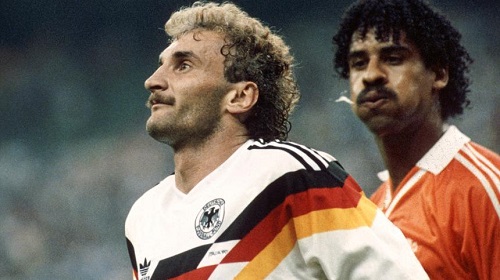
The 1990 edition is filled with cynical, negative football, if football is indeed the word. Tactics are horribly defensive. Goals are almost impossibly hard to come by. Games are a stop-start travesty of fouls, dives and whines. Claudio Caniggia is assaulted by three Cameroon players in quick succession in the opening game. Maradona spends his entire tournament being hacked down or diving to avoid being hacked down. A record number of red cards are handed out. Frank Rijkaard twice spits at Rudi Völler, yet Völler is sent off. Gary Lineker dives to win a penalty that helps to keep Cameroon out of the semi-finals. Argentina drug water bottles they then allow Brazilian players to drink from. Ireland 'arrange' the closing stages of their match against the Dutch to secure qualification from the group stages, and make the quarter-finals despite winning no games and scoring two goals. Argentina finish as runners-up after winning just two games. The Germans win the tournament scoring three goals in their last three games: two penalties and a heavily deflected free kick. Not one but two players are sent off in a terrible final. This remains the greatest World Cup of all time.
1994
The United States yet again ruin soccer by calling it soccer and going to the matches in huge numbers. After Argentina's game against Nigeria, Diego Maradona is led away for a drugs test by an official who looks very familiar although no one can quite put their finger on it. The Germans merge with the East Germans to form superteam The Germans. This somehow makes them worse. Stefan 'Effin'' Effenberg is sent home by manager Berti Vogts because you would, wouldn't you. Many games are played in temperatures that are blatantly discriminatory against teams from northern Europe. Sweden finish third.
1998
Adidas claim that their official World Cup football, the Obélix, is the roundest ever, thus solving a great problem that has long bedevilled the game. Dennis Bergkamp does not stamp on Siniša Mihajlović. Zinedine Zidane turns up fashionably late and steals the plaudits as France win. Fontaine, and just Fontaine, presents the Raymond Kopa to Didier Deschamps. Lilian Thuram, Marcel Desailly, Laurent Blanc and Bixente Lizarazu are dismantled, shipped to China and reassembled brick-by-brick to dam the Yangtze.
2002
The World Cup is awarded to the sci-fi technotopia of Japan/South Korea. To celebrate, the organisers decree that it will be the first tournament ever to be staged in the future. Unfortunately, the confusion over dates leads to many of the favourites not turning up. The official ball of the World Cup is made of pure neon, making it the most visible football ever. Keepers still complain about it.
2006
Swarthy Latin Cristiano Ronaldo grabs Wayne Rooney's foot and stamps his own gonads with it, thus getting the greatest player in the world sent off. Ronaldo finds his camera and winks, taunting the English by slyly referencing the derivation of the word 'connive' from the Latin for 'wink'. The next day he reveals his nefarious plan in a tell-all memoir called How I Got The Greatest Player In The World Sent Off.
To celebrate the 500th anniversary of the World Cup, a special re-enactment of the first ever World Cup game is held. Everyone goes home happy with no lingering bitterness or recrimination.
2010
I don't know?
2014
The world is plunged into mourning as Neymar is shot dead by top bad Colombian Pablo Escobar. The World Cup is cancelled in what many suspect to be an elaborate Brazilian conspiracy to deny Lionel Messi the chance to win the World Cup on his own. As part of Neymar's funeral, a game is held between Brazil and the Germans. Brazil honour Neymar's memory by being completely shit at football without him.
2018
Croatia win the final on penalties after a 1-1 draw with France.
2022
The FIFA controversially decide that the World Cup will be held in catarrh. The tournament is moved to the winter to allow more catarrh to be produced.
Read more... Read more...
12 July 2018
Contact
There is a growing fashion in football for attacking players at corner kicks to huddle close together in groups of three to five in the middle of the penalty area, waiting to split off in different directions as the kick comes in. (Ninety percent of England’s attacking strategy at the World Cup has consisted of this.)
It's striking, because football is one of those games where colleagues tend not to make physical contact with one another during play (or even in a moment preparatory to the ball being put back into play). Instead, the ball is a stand-in, conveying contact from player to player.
There used to be a fashion for mocking footballers for 'over-the-top' goal celebrations involving any physical contact beyond a simple handshake and maybe some hair-tousling if the would-be tousler was feeling particularly exuberant. Maybe, on some level, players want to turn the touch-at-a-distance that playing football entails into something more direct for a moment.
Rugby players do it all the time: the pack bind intimately in the scrum; they form phalanx-like mauls; they pile into rucks; they lift each other at line-outs. Footballers can't do that.
In fact, when players from the same football team do make contact with each other during play, it's usually bad news. I was at a game recently where two teammates collided with one another in a manner traditionally described as 'hefty'. Both ended up on the ground. One, lying on his back, lifted his leg; the foot, instead of pointing to 12, was, let's say, unnaturally directed towards the setting sun. There were many minutes of injury time. Read more... Read more...
08 July 2018
Let's have some new clichés
Those acutely conscious of the fact that football wasn't invented in 1992, you know, will have been delighted by how Fyodor Smolov decided to open Russia's World Cup quarter-final penalty shootout. It was an inspired homage to a penalty taken by none other than Diego Maradona in Argentina's 1990 shootout against Yugoslavia: a gentle game of catch with a Croatian goalkeeper (then, Tomislav Ivković; now, Danijel Subašić). Behold, ladies and gentlemen, the state of this:
A cherished World Cup memory of mine is Maradona's penalty in the shootout of Argentina's next game, the semi-final against Italy. He allowed Walter Zenga to dive to his right, and oh-so-slowly rolled the kick far away to the other side, the ball perhaps (it's a little hard to tell) even kissing the inside of the post as it went in.
Looking back at the video, I realise that's not quite how it happened.
But then, I never said that's how it happened. I told you what my memory of it is, and imagination has improved on reality. (The reality wasn't bad either, mind you.)
Perhaps this is what afflicted Smolov. In his mind, he probably saw himself performing the perfect Panenka. What he got was the horrific reality of trying to coolly swim in that particular shark tank.
The Panenka is a devalued currency. For one thing, as chapeaux go, it's quite the vieuxest. For another, all kinds of nonsense have been awarded that grand title. Here's Antonín Panenka's original (and best, according to Tina Turner):
And here's Zinedine Zidane's from the 2006 World Cup final:
Chipping a "Panenka" that high is a safe way to do something that ought to be dangerous. Calling it a Panenka is like claiming to have circumnavigated the globe by walking around the North Pole and it at arm's length. A Panenka should softly stroke the goalkeeper's hair and whisper in his ear: "ya prick".
There are three perfect penalties, and on this I'll hear no argument. One is a genuine Panenka. Another is the Pressman:
The other is one yet to be made manifest in the inadequate construct dignified by the name "the real world". As Maradona did with Zenga, it uses the goalkeeper's propensity to pick a side to dive on. The taker would then kick the ball to the other side of the goal at the slowest possible speed for it to cross the line. It's a penalty that says: "This is how little energy I need to waste on this charade".
This penalty also comes in a deluxe version wherein the keeper, sprawled on the wrong side of the goal, has just enough time to realise what's going on, get up, dive back across the goal and ... just ... get ... a ... fingertip to the ball ... which only directs it towards that spot where it simultaneously hits the inside of the post and the beautiful, beautiful side-netting.
Proof, still more proof, that in my mind — where it really counts — I'm a better footballer than Zinedine Zidane. Read more... Read more...
06 July 2018
Stand up straight and tall like your back’s against the wall

So there he is, fed the ball in the right-hand channel by Mascherano. He's in enough space to allow the ball to run past him as he turns to face the Germany goal. Now thirty-five yards out, he meets Schweinsteiger. His first touch starts the engine; the second sets him on his way past his opponent. But just as it looks like he's about to reach that point of no return — the momentum that will commit him and the line of five defenders at the eighteen-yard line to whatever will be — Schweinsteiger slides in and brings him to the ground.


By the time Schweinsteiger has had his cramp/premature rigor mortis tended to, two more minutes have elapsed. The World Cup final is now well into stoppage time at the end of extra time. Argentina have a free kick thirty or so yards from goal, and there's only one man who can take it...
his entire World Cup reduced to him standing there, right in front of the penalty spot, head bowed, hands on hips, lame of hamstring, burdened of shoulder, stuck in the warmth of the SoCal sun (it won't ever diii-iiie) on what turned out to be a Copacabana teeming with a jubilating samba school led by — say it with feeling — DungaIf there was justice in fiction, the film might end there. With no resolution offered, you would have to consider what was so important about a resolution anyway. Why should so much rest on this one round of what-happened-next? By now, he has done so much in football for so long that everyone has their minds made up about him anyway. Hangarfuls of evidence already exist for anyone to use to support or dismiss any theory or belief about him. This moment would merely be another exhibit in the case of whatever you want it to be.

The trouble is, the future can't be trusted with itself. It's a beautiful, pristine void. Leave it be? Really?
and then everything that had gone before: him (after a group phase in which he and Italy were muck or not much cleaner) bursting through the knockout rounds in fits of desperate elegance all those other chancers could only dream of: a breathtakingly nerveless first-timer to equalise with scant time remaining against Nigeria, topped off with an extra-time penalty to clinch the winWith someone else's talent, you can really go places. It's fuel for fantasy. You can make whole worlds from the stuff, and no-one can stop you. And you owe it nothing; you can do what you like with it. You are stealing something without guilt or fear of retribution. It practically begs you to steal it, and it sitting out there in the open: football is a public work, not the jottings of a shy poet. It invites wanton irresponsibility.

In such conditions, prudence is a bore. One trap, one finish, one drop of the shoulder can be enough to make you want to see more. Until then, you can imagine it. Once you've seen it in the stadium in your mind, you want to see still more. Until then, you can imagine it. People go mad this way.
cordially inviting Zubizarreta to allow the ball to be taken around him to set up the late winner against Spain (even making up for the subsequent touch that had taken him "too far" wide)A player between games isn't really a player — just another human being, tragically like you and me. It's almost a duty to dream big on his behalf: it re-animates him; it allows him to be at his grandest even when he's fatigued.

It's a way of taming the terra incognita that is the future. You fantasise, or speculate, or guess. You wear lucky garments and follow hopefully beneficial routines. You create torrents of previews, predictions, tinpot precog. You turn the game into an exam in which you set the questions and mark the papers. You try to define 'legacy': to determine in advance what those in times to come will think about what hasn't happened yet. It's a strange kind of legacy: one that mixes up past and future, legator and legatee. It's as if, despite what Kierkegaard said (okay, it was the Manics), life can only be understood forwards but must be lived backwards.
that shimmy along the 18-yard line, good God, for the first against Bulgaria, then his blessing of Albertini's gift of a pass to make it twoIt's some kind of compensation or revenge for always being a split second late to whatever happens on the field. A player does something, and you can only react. The demarcation is strict. You're a moth crashing into a window. You don't have the privilege of being able to write the chapter that starts like this—
—or that starts like pretty much anything. All the intuition and science — continuously and vigorously refined though they may be — that are brought to bear on mapping the game must at kick-off take their proper place behind the players and fortune: together, the permanent advance guard, the prow of the ship. Eduardo Galeano said: "It definitely depends on fate, which like the wind blows every which way." If there's any poetry to be had, it will come from the earthbound reality of ball, boot and grass, which you have no direct access to.
and how it looked as if he was the one person capable of looking the World Cup in the eye and actually acting in concert with it. He was using its inexorable momentum, as it sheds half its pretenders at a time, in his favour, rather than allowing himself to get stampeded by itAfterwards, though, you can lay claim to whatever has happened, and go to town.
True, World Player of the Year plays well at the World Cup makes a certain kind of sense. But sense has nothing on the World Cup. As the tournament progresses and the vice tightens, nerves prickle and wound even the best. With courage and panache, Baggio was both ennobling the World Cup by giving it something to contrast with and complement its reputation as an easy destroyer of men, and using it as an instrument to project and amplify his talent beyond even what the cathedrals of the almighty Serie A could doYour conception of the future is constrained by your knowledge of the past, which tends to shed complexity. It seeks emblems on which to place a gross retrospective burden, which, via these emblems, becomes someone else's present-day burden. Hence the epithets given over the years to those blessed/cursed with potential: all those Cruijffs of the Carpathians, the Eusébios of the Steppes, the Drogbas of the far side of Drogheda, last month's Next Maradona. You know Maradona? The lad who won a World Cup all on his own?
Fantasy makes demands at once simplistic and grandiose.
Moreover, in both his style and the timing of some of its most exquisite expressions, he seemed to be displaying a deep sympathy with football's dramatic potential. He was playing in dreams, which involve a scabby early goal and an hour and a half of desperate clinging on only in the minds of specialists'Dominant' is a word too ready to the tongue in sport. It evokes a bowling ball skittling skittles, and defences haven't been that obliging in centuries. If dominance was what this caper was really about, then LeBron James would have a hundred points a game and the other fella five hundred hat-tricks instead of a measly fifty-odd. But they don't: they have to pick their paths just like anyone else, and those paths are limited in number and by time. They're just better at picking them, and what's a path for them might be a dead end for others.
'Dominant' doesn't tell you how something happened so much as it describes the effect of having witnessed it. It refers to you on the floor, the blast having thrown you there; it doesn't describe what caused the explosion. You don't have to know every forensic detail, the thousand things that conspired to set it off. Someone does. But you don't, for your ears to be ringing and your face to be set in a stunned smile.
Or, you might say, he was playing in a World Cup, a dreamland all its own. The heightened and often preposterous tenor (howya) of a World Cup is built on big demands seldom met (starting with the demand that the football be any good, which is just plain unreasonable). Baggio matched that tenor and made it seem fair and unpreposterous. Or maybe righteously preposterous. Either way, he played that thingAn appreciation of a simple (or not so simple) act of beauty, a rational assessment of a player's body of work: they are pleasures in themselves, and only a maniac would be so unfair as to deny a player such consideration. (There are a lot of maniacs.) But you also yearn for symbols of that talent: moments that condense its truth into a form that will leave a permanent mark on anyone so much as passing by. You need to see that it's more than just another pretty evanescence. You need to see immensity in that talent, to be shown its life-affirming properties with graphic exaggeration.

In other words, you need it to see it as a story. Sport is stories on stories on stories — stories all the way down. Stories are selective, partial; they usually involve jeopardy. The simplest story is: will he or won't he?
Maybe there's some cruelty in that, something a tad sadistic in the wish to make someone play a role in such a production, and in the refusal not to simply accept every manifestation of their talent as uniformly valid currency.
Talent in sport is non-transferable. A player can't bank it and wait for it to mature and grow plump, or wear it round his neck as an accolade — it's only useful when it's being used. This must haunt him.

What does Lionel Messi make of it all? He has to play his football touch by touch, at one moment per moment. It’s a life where he’s all performance, but everyone else is the editor.
and although it would be nice, even generous — bearing in mind that we don't talk much about, say, yokeybuzzer who missed in the 1988 European Cup final shootout, or the player who cost Sweden a place in the Euro 2004 semi-final, who was it again, och, you know who I mean, I think his name had an e in it — to forget about the bleeding miss, which people only bang on about because before the crash, he soaredPerhaps he resents the fact that greater command over his game should yield greater freedom, but actually becomes an encumbrance. He has to live everyone else's lives for them before he can live his.
Or maybe he wants to make the story his alone. Maybe he sees it as a chance to allow the pride he surely has in his ability to shine like the sun, and to connect the pleasure he obviously feels from playing the game to the pleasure of others — to complete the circuit. Maybe — just maybe — he wants to be recognised as the greatest.
I fantasise, or speculate, or guess, that he feels both sides, alternately or even simultaneously. When things are going well for him, that slight hunch in his back looks like the source of his propulsion as he runs. When they are not, it looks like a symptom of having to drag the weight clinging to his left ankle. He probably welcomes the weight and curses it at the same time.
Not that I know. He doesn't tend to favour us with the confidence. Jorge Valdano says he is "one of the best-known men in the world but whose silences no one can interpret". He leaves a space for you to fill — a beautiful, pristine void.
to deny the ending would be to deny the excitement that led up to it — when each successive goal rippled back to those previous, and rippled forward again, spilling over boundaries, altering meanings, creating expectations — and to deny the act of letting go and submitting to what's happening is akin to undoing a chain reaction of chain reactions, which might just be possible to do afterwards in cold blood, but at the time only in a state of bloodlessnessThe simplest story is: will he or won't he? The biggest story is the World Cup. In 2006, Messi wasn't trusted by Pékerman when it counted. In 2010, he got buried beneath Maradona's shockingly Maradona-like qualities. In 2014, he has hacked out of granite defences first place in their group for Argentina. But he's ghosted through much of the knockout phase, hobbled by injury. (Galeano saw in Maradona "the body as metaphor": "He was overwhelmed by the weight of his own shadow. From that day long ago when fans first chanted his name, his spinal column caused him grief [...] his legs ached, he couldn't sleep without pills.")
Even so, Argentina have had just enough about them to haul themselves inch by inch to the final; they got through the first three knockout rounds by an aggregate score of 2-0. Today, in the final, they've forced Germany to go the long way around. Germany finally went ahead in the one-hundred-and-thirteenth minute.
Now, well into stoppage time at the end of extra time, Argentina have a free kick thirty or so yards from goal. They are not a great team. Perhaps they shouldn't even be here. But here they are, with one last chance to keep themselves in the World Cup, and the German players on the sideline and fans in the stands are looking very happy for people who’ve seen the 2012 Champions League final.

and even though he was crocked from the semi-final, all that had happened had combined with fine timing to ensure that for a World Cup final, he was undroppable, then unsubbable, and when it came to the shootout, securely bound to be one of Italy's first five takersWhen the legend becomes fact... Fact is ball, boot and grass; legend is how you lay claim (or he lays claim) to whatever has happened, or might yet happen. Fact moves constantly around the field; legend pursues it and tries to make it do its bidding.
(did Sacchi, even Baggiosceptic Sacchi, select him at number five because of that kick's importance, should it arrive, or was it because he wanted to protect Italy by pushing Baggio as far down the list as he could bear?)So there's only one man who can take the free. In theory, he could dink it into the penalty box to one of the many blue jerseys waiting to pounce on it
(or even protect Baggio?)but the fact of the legend is that there's only one thing he can do: he has to shoot. It's his job: God forgives; Messi answers prayers. He's meant to be the greatest, or one of the greatest, or potentially the greatest, of this time, or of that place, or of all times and places, or something. To try and set a teammate up instead would be an abdication of his duty — if it didn't result in a goal, anyway. He wasn't given his gift so he could pass it up, at this of all times.

and sport never promises what you will see, only that it will make you look

So even though the free is right at the limit of his range, perhaps slightly beyond it

even though he's injured

even though he's probably feeling some deep tiredness at the end of a long game, a long tournament and a long season

even though his muscles must be afflicted by the tension of the biggest match of all

even though all these factors will mean he'll have to try and strike the ball with considerable power, at the expense of a great deal of control

even though this will mean there's only one direction the ball's going to travel

he has to shoot.

and besides, he was hardly going to say no, was he?

28 June 2018
A fixity of fixtures
World Cup Permutation Week, concluding today, brings to mind the infamous West Germany-Austria game that finished Group 2 of the 1982 World Cup. This was the one in which the teams knew that were Germany to win 1-0, both sides would qualify for the second round ahead of Algeria. And wouldn't you know, Germany scored early and both teams lazed conspiratorially in the Basque sun for seventy-nine long, crooked minutes.
Eager to know what such a deformity actually looks like, I tried in vain to find a video of the full game. However, I did find this brief video, which hints that there was more action after the goal than is usually recalled. The Guardian's Rob Smyth, meanwhile, has seen the match in full, and has written a fascinating piece on it. Per Smyth:
"The video of the game is thus a surprise. You expect side-to-side stuff, players standing around picking spots and scratching backsides, not giving 10% never mind 110; the greatest sham on turf. That only really happens in the final quarter of an hour, when the game properly livens down, and even then it is no more brazen than subsequent examples of two teams settling for a specific score."
Which makes it sound a lot like Ireland-Holland in the final round of games in the draw-laden Group F of the 1990 World Cup. With the score at 1-1, and England winning 1-0 against Egypt, the live table looked like this (F-A Pts; two points for a win in those days):
ENG 2-1 4
IRL 2-2 3
NED 2-2 3
EGY 1-2 2The Irish and Dutch players knew that were the scores to remain the same, Ireland and Holland would finish in joint second place in the group: level on points, goal difference, goals scored and head-to-head results. (Fair-play records — the tie-breaker that has done for Senegal in this year's edition — did not come into it.) This would mean that they would have to be separated by lots. Both teams would qualify for the last 16, because whichever of the teams fell to third place would guaranteed a place as one of the best third-place teams. (This being the last group to conclude, the teams thus had an advantage over the third-place teams from other groups. Ireland enjoyed the same advantage at Euro 2016.)
Ireland and Holland bet on Egypt not scoring, and gently played out the remainder of the game. The bet paid off, and the lottery went ahead. Ireland 'won' it, claiming second place and a second-round tie with Romania, which went pretty fucking splendidly. The Netherlands had to play West Germany, which didn't.
But suppose Egypt had equalised against England. That would have meant all four teams would have had the exact same record. The final standings for the entire group would have decided by a four-team lottery. It would have been the greatest moment in World Cup history.
Another scenario. Let's say one of Ireland or Holland somehow accidentally scored a second and unfortunately clumsily won 2-1. For the purposes of this thought experiment, we'll call that team Ireland. (You'll have to imagine Ireland scoring more than one goal in a tournament game, but you can do it if you just believe.) That would have put Ireland top, ahead of England on goals scored. Holland would still have finished in third, ahead of Egypt by the same means. But they would not have automatically qualified for the second round. Their record of F2 A3 Pts2 would have given them the joint fourth-best record amongst the third-place teams, level with Austria and Scotland. With the four best third-place teams qualifying, Holland, Scotland and Austria would have been the lucky lottery contestants, only one of which would have gone through.
As it happens, in the 1994 World Cup, Ireland again finished their group with the joint second-best record; this time, the other team was Italy. Ireland, you may recall, had beaten Italy, so finished in second place without need of Sepp Blatter's balls/bowl carry-on. All four teams in that group had four points and a goal difference of zero. Mexico won the group on goals scored; Norway ended up in fourth, hitching a lift home on a long ball from one of their centre-halves. (Ireland would never do such a thing.) Read more... Read more...
17 June 2018
As good as a goal
There are great misses. Pelé's two classics in the 1970 World Cup are well known. There's also this from Pavel Nedvěd in the stupendous Czech Republic-Netherlands match in the group stage of Euro 2004:
And this header by Henrik Larsson against Russia in the succeeding Euros would have been famous had it dropped in:
And yesterday, Peru's Paolo Guerrero sent a backheel hopping towards the neighbourhood of Kasper Schmeichel's far post. It took many years to reach its destination. Watching, you don't spend that length of time in suspended animation, waiting to register the outcome: instead, that outcome where the ball goes in draws itself in your mind. You get an advance copy of the goal to come; or if it's a miss, you get to see a wonderful alternative future.
Guerrero's shot went just wide — agonisingly so, to use the commentator's fitting cliché. But the agony is sweet, because on the pitch in your mind, Guerrero scored his beautiful goal.
Sweet, that is, for the neutral. If it's a player on your team who's missed, it can be sickening.
Another miss. In the last minute of extra time in Chile's last-16 tie in the 2014 World Cup, Mauricio Pinilla fired a shot from the 18-yard line high towards the Brazil goal, and before it opened up the extraordinary reality that Brazil were going to lose. It had been theoretically possible before then, of course. It was apparent that this Brazil team were not the finest vintage, and Chile were a very good team themselves: certainly good enough, on their day, to beat Brazil. The game had been in the balance throughout its thrillingly bitter two hours. But this was Brazil. The notion of Brazil — Brazil! — getting knocked out in the second round of their own World Cup was unreal. It couldn't happen. No matter how perilous the waters they might find themselves in, some piece of fortune (or a kindly referee) would lift them to safety. But there it was. The ball was in midair, and everyone was helpless.
The shot did not go in. A whole world of which this catastrophe was the creation story had been made by Pinilla's boot, then destroyed by the crossbar, all in the time it took for the ball to travel eighteen yards. Brazil won the penalty shootout and felt relieved that their humiliation didn't materialise on that field in Belo Horizonte.
Meanwhile, Pinilla got himself a tattoo commemorating the moment. He knew something. Read more... Read more...
06 June 2018
AFC-S Mithering – or – Football’s Mr. Sorrow

There's no good reason why a team like Arsène Wenger’s Arsenal, 1996 to 2004, should exist. There's nothing inevitable about it. Much of football is an expanse of earnest attempts at creating a beneficent order, leaving behind a trail of small individual moments of triumph or beauty each of which could, nonetheless, have been a happy accident, a rogue episode, a cloud that momentarily looks like Australia. Maybe even something you could have done. You could, of course, happily mark your time by such moments — at the very least, they show that something is happening out there.
But when some of those points of light are threaded together; and, deeper still, when more follow, and the threads begin to connect, and the connections proliferate ... I don't just mean winning, or even winning frequently (how mundane — there's always a winner), but a team that seems to be operating with a higher intelligence — nothing mystical or transcendent or other such shite, but something very human. They create something new and unforeseen with the same materials available to everyone else. They don't defy the laws of the universe or the mind: they know those laws, their convolutions and nooks; they know how to work them. They know the hardness of reality. You can't transcend it, only ride its contours — and perhaps in so doing bring a fresh eye to them.
The "beautiful game" can be an abstraction if you forget that even the bowling greens of the Premier League leave muck between the players' studs. It's always a balance between sun and shadow, fun and serious purpose, play and fight. (And the cascade of red cards that fell upon Arsenal in the early Wenger years shows they certainly used to fight. Or did they just lash out?) It's power and grace, sleekness and blunt force hinting at violence...
Maybe it's not even really a balance. There seems to be a sweet spot where apparently opposing notions like teamwork and individualism are no longer in inverse proportion — where they don't conflict, but enhance and transform one another. Reach that state and a team can become so entirely fit for purpose that they give you the illusion (it's all illusion) that football has at last been solved.
That's beauty beyond prettiness. Most of football's primary pleasures are small and subtle: a well-controlled ball, a nice floodlight pylon, the opposition goalkeeper slicing a clearance out of play. It's mad, but it's not that mad. It's nice to have something bigger in reserve, though.
And for it to happen to your team, i.e. the side of all that's holy and righteous … I was already an Arsenal fan before Wenger became their manager. I was hardly "long-suffering": I was far too young for that; and besides, I came to Gooner consciousness during the George Graham era, which brought titles a-plenty, as well as a style of play that would make many a more recent convert puke. (When it worked, it was fabulous, by the way.) Nor, evidently, can I claim to be one of those converts, seduced by the beauty, drawn ever deeper by the refined pleasure of a Wenger team. I just got lucky. Jammier than the M50. Right place, right time.
If, as Roger Angell says, baseball is about belonging (Angell seems to have belonged to about four different teams, and fair play to him), so is football. And better that the good stuff belongs to you than to them.
The trouble with sport is that it's a never-ending story. Rare is the conclusion that is not provisional. No matter what you've done lately, there'll always come along a new table full of zeroes that somehow has to be shaped. To the defeated, "there's always next year" is a consolation; to the victorious, it's both a seduction and a threat. Next year gives you the chance to parlay your achievements into something more, and to deepen your exploration of the game's unknown possibilities. More than that — it demands it. It also, of course, gives you a chance to lose it. Whatever comes to pass, it's impossible to preserve the present glorious moment just as it is and leave the future well alone. Or the past.
The memory of those early Wenger teams was too vivid. Even as the constant forward movement congealed into the Islington Shuffle and thence into something even less self-assured, there were frequent manoeuvres and performances that rhymed with those from what increasingly became the old days. Even as good form failed to turn into a title challenge, or a title challenge was halted by the inexplicable refusal of a fence, there'd always be a reminder that the old spirit was still there — even if it rested solely in the person of Arsène Wenger, who seemed to be less and less able to get it to connect with the players in his charge, or with the changed realities of the game, or with the expectations of five-star football on a four-star budget, or with what tethers idealism to the ground.
(It’s by some pretty warped standards that losing to Bayern and finishing fourth could be seen as abject failure, but losing to Bayern and finishing fourth losing to Bayern and finishing fourth losing to Bayern and finishing fourth losing to Bayern and finishing fourth losing to bayern and finishing fourht losingto bayern and finishing fourth losing to Bayern and finishing ourth losing to bayern anf finishing fourth lsing to Bayrn and finishing fourth losingin to Bayern and finishing fourth lsoing to Bayern and finihsing ofurth losinginto Bayern and finishing fourth losing to bayern and finishing fourth losinginto Bauern and finsihing fourth losing to Bayern anad finsihing fourth osing to Bayern and finishing fourth losing to Byern and finishiing fourth is at least a tester, like being a weatherman in Punxsutawney.)
The hope prompted by that spirit, its myriad little inflations and deflations, was a gambler's hope. It became wearing, exasperating, ever more difficult to sustain. I don't know whether Wenger should have gone after the 2017 FA Cup final; I don't know how much of a difference another year in twenty-two really makes. That game was a stunning recapitulation of the Wenger way. In 2017, it was also a reminder of the bits in between the rhymes, and thus of the W. w.'s waywardness. It was proof of the faith, and of its opposite.
There was no real shock of finality at the announcement of Wenger's more-or-less forced exit: the end of his tenure was a slow dissolution, not a point in time. More final was the send-off at his last home game, which could have been called "Fuck Off & Thanks for Everything" but for Wenger's graciousness making it less weird for (almost) all concerned. But it hit home the hardest once the whistle blew to end the second leg of the Europa League semi-final against Atlético Madrid. Arsenal were not the pre-tie favourites — but on paper, and then on grass, it was winnable, and they lost. The thing slipped through their fingers one final time. And that was that. What would a Europa title have been worth anyway...? Too late to answer. Time's up. Here comes Just Another Manager, to be followed, no doubt, by Yet Another Manager.
The long-time Wenger-Outs – hard-line, hard-headed, possibly hard-hearted — were probably right, or at least accurate. Me? Like someone said after another doomed, damned escapade, I'm a little bit stupid regarding this type of thing.
"It's very unusual," says Amy Lawrence in the documentary 89, talking about Graham's Arsenal's title-clinching win in The Anfield Game,
when you're experiencing something in the present, that's happening to you now, and you know that it's going to be something you'll cherish for the rest of your life.The corollary thought is: it may never be this good again. Into that moment which seems, magically, to be a frozen present tense, is fed the past, with all its hopes and disappointments, and the future, which won't be as good as this. There it is, right there: that strange figure in the background staring at the camera, who you only noticed the hundredth time you looked at the picture. Things fall apart; it's as true as the ecstasy. Everything a team does after they assert what greatness they have to assert is an attempt to hunt that thought down, capture it, and subdue it. Alex Ferguson's Manchester United chased the thought relentlessly and ruthlessly, plucking its wings off with savage glee. Arsenal did not, or could not, do that, so it constantly buzzed around them: occasionally swatted, never squashed. They became its emblem.
Read more... Read more...